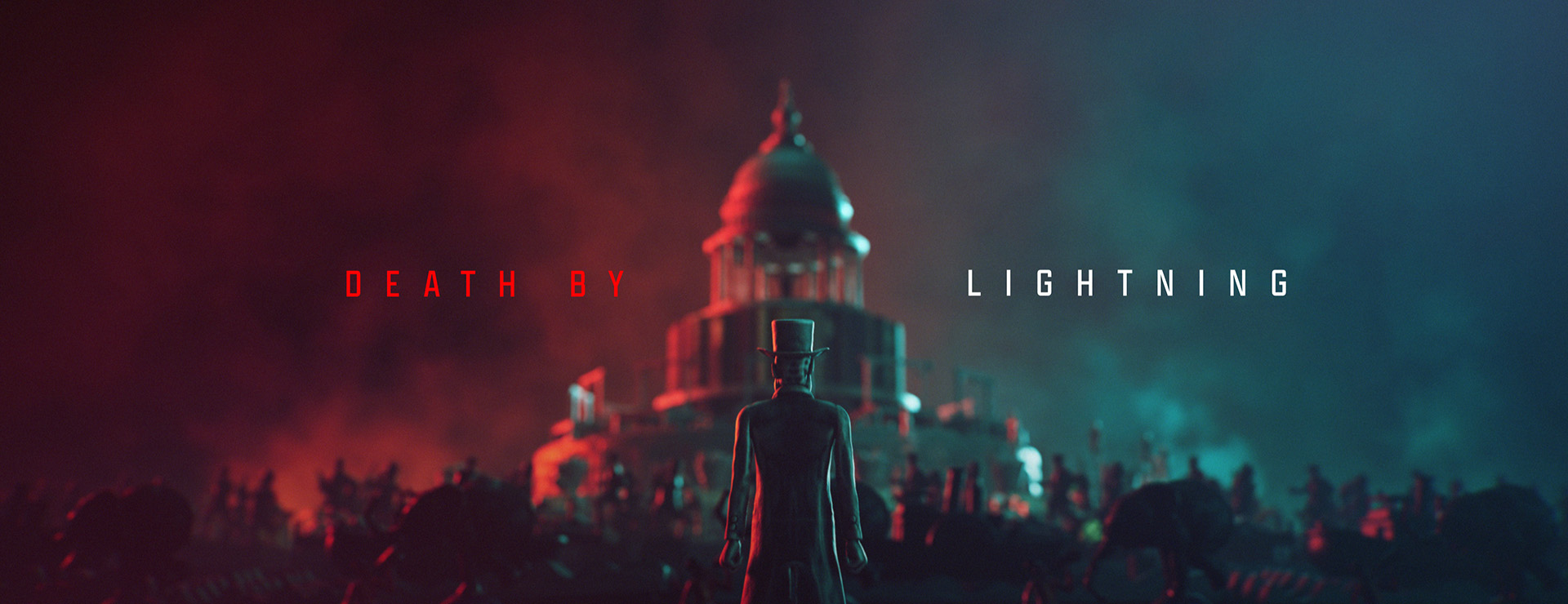
For the Netflix limited series Death by Lightning, Los Angeles-based creative agency King+Country created four versions of the main-title sequence to tell different parts of the story.
The series, created by Mike Makowski and executive produced by Games of Thrones’ David Benioff and D. B. Weiss, is a psychological and historical exploration of the relationship between President James A. Garfield (Michael Shannon) and his assassin, Charles Guiteau (Matthew Macfadyen). At the center of the studio’s creative approach was a custom-built animated zoetrope – a pre-film device that spins to make still images look like they are moving. Pairing the zoetrope effect with multiple 3D scenarios transformed nineteenth-century politics into a meticulously crafted mechanical world.
King+Country decided to use the zoetrope not only for its historical relevance but also for its poetic potential. Invented shortly after Garfield’s birth, it created a natural link to the era. While the original tool relies on static objects, King+Country expanded it into a sprawling mechanical landscape filled with gears, pistons, ropes and pulleys.
King+ Country began its development process with deep historical research into early animation devices, political cartoons, industrial machinery and the social climate surrounding the assassination. These references guided the sequence’s visual language. Each slice of the zoetrope tells its own story: Garfield unicycles a tightrope surrounded with knives drawn from political cartoons of the era, Guiteau hops across piles of cash away from the cops, shadowy bankers quietly pocket coins. Even the strangest beats, like a head being chopped off by a feather, are rooted in real attitudes or events of the time.
“We wanted to capture the spirit of the era without turning it into a museum exhibit,” said Rick Gledhill, director and partner at King+Country, in a statement. “The zoetrope gave us a foundation that could hold the emotional weight of the series and the repetition of the machine creates a rhythm that feels permanent and inevitable. Something that keeps turning long after the people inside it are gone.”
Every part of the machine was built from scratch. The team then created a digital library of gears and mechanical systems, each designed to behave believably once animated. Many details appear for only fractions of a second, which required exceptional precision during modeling and layout.
"The goal was for every component to feel physically plausible, even if the viewer only sensed it on a subconscious level," said KA Batcha, art director, also in a statement. “The small details flash by for only a moment, but that is what makes the viewing experience so rewarding.”
Lighting and atmosphere became a creative chapter of their own. After testing many approaches, the team landed on a moody backlit look with a shallow depth of field.
“We built the piece to feel rooted in the period but unmistakably modern in execution,” said Animation Supervisor Andrew Cook. “The machine never fully reveals itself. It is intricate, imperfect and always in motion. That tension mirrors our characters in ways that felt honest to their stories.”
Across sequences referencing Chicago, Washington, D.C., and the industrial atmosphere of New York’s Port Authority, the zoetrope became a metaphor for a system that both elevated Garfield and consumed Guiteau. It represents a country wrestling with reform, ambition and delusion.
“We leaned into the madness because the story earned it,” says Gledhill. “History gave us a perfect metaphor. Our job was simply to bring the machine to life.”
"We’re well known for our work on historical drama main titles, with our Emmy for Good Lord Bird highlighting that expertise," said Jerry Torgerson, executive producer and partner at King+Country. ”When we’re challenged to create something truly original, that’s when our team delivers its strongest work."